USA Ryder Cup 2027 Qualifying Rules: What Changed on September 9
The USA’s new Ryder Cup qualifying race starts in January 2027. See the winner points, six automatic spots, excluded events and why 2026 results do not count.
Players Mentioned
The United States has confirmed a new qualifying process for the 2027 Ryder Cup. The September 9 announcement answers the question that had remained open through the summer: American points will be earned in 2027, with no contribution from this year’s results.
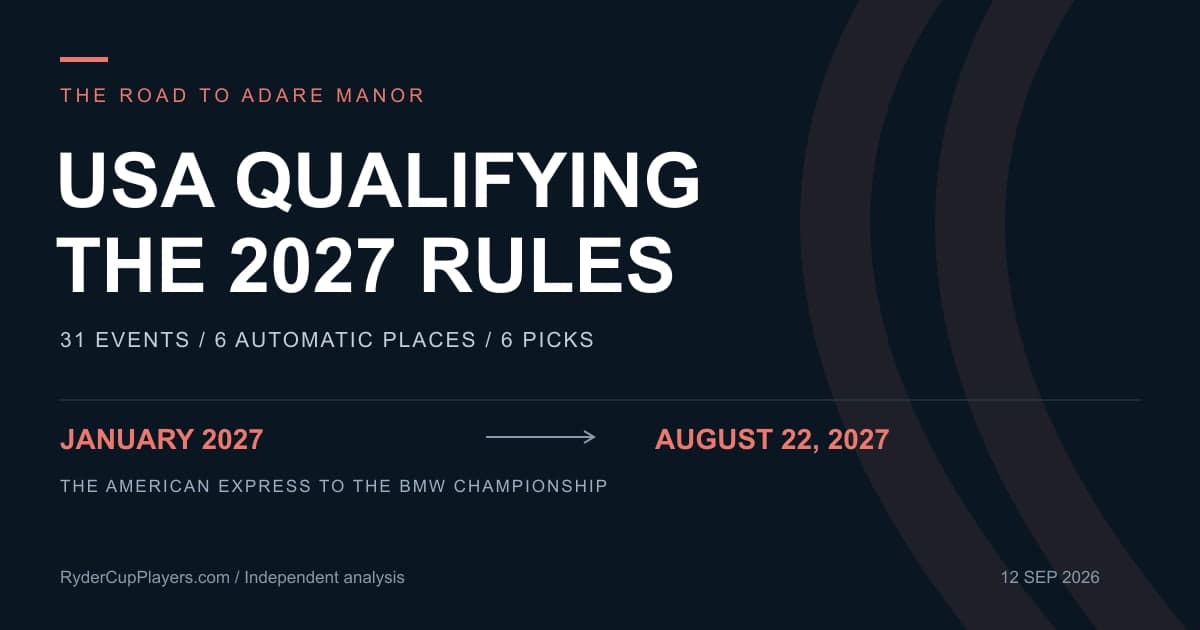
The PGA of America announcement defines a 31-event race from The American Express, during January 18-24, through the BMW Championship, August 16-22. Six eligible players qualify automatically. Jim Furyk makes six additional selections during the week of August 30, after the TOUR Championship.
This is a rules announcement, not a standings update. The first American qualifying points have still to be earned. The main Ryder Cup qualification tracker keeps the U.S. pre-start status separate from Europe’s already active list.
The confirmed U.S. winner points
The four event categories reward a winner as follows:
- Major championships: 3,000 points.
- THE PLAYERS Championship: 2,850 points.
- Signature events and the two counting Playoff events: 2,250 points.
- Regular full-field PGA TOUR events: 1,500 points.
The schedule includes four majors, THE PLAYERS, eight Signature events, two Playoff events and sixteen full-field tournaments. Opposite-field events are excluded. At the Zurich Classic, both partners must be U.S.-eligible to receive points, and a separate distribution applies.
Other qualifying finishers receive points according to the official finishing-position breakdown. The numbers above are winner awards; they should not be applied to every made cut or used as an event-wide pool.
Why the change matters for reading results
The previous cycle connected American Ryder Cup points to money earned. The new system assigns values by tournament type and finish, with the qualifying race confined to the year of the matches.
Our interpretation is that this makes the categories easier for readers to compare. A purse increase is no longer enough, by itself, to explain a larger Ryder Cup reward. The relevant questions become which category an event belongs to and where a player finishes under the approved schedule.
That does not make all wins equivalent. A major victory still carries more weight than a full-field victory. Nor does it remove the importance of consistent finishes: the winner amounts are only the easiest reference points, not a complete model of the standings.
Three useful comparisons
The following are calculations from the published winner awards, rather than additional selection rules:
- One major win equals two regular full-field wins in points: 3,000 compared with 1,500 plus 1,500.
- A Signature-event win is worth 50% more than a regular full-field win: 2,250 compared with 1,500.
- THE PLAYERS winner receives 95% of a major winner’s award: 2,850 divided by 3,000.
These comparisons help explain the scale without forecasting an automatic qualifying total. There is no fixed points target in the announcement that guarantees sixth place. The threshold depends on how eligible players distribute results across the season.
A hypothetical player winning two regular events could match another player’s major-winning points from those victories alone. Their complete totals could still differ substantially because of every other counting finish. It would be a mistake to treat the comparison as a prediction that two wins secure a place.
What happens to the 2026 major results?
They remain evidence of golf performance, but they do not become U.S. qualifying points. That distinction affects how to read our Royal Birkdale analysis, including the cases made by Cameron Young and Sam Burns.
An analyst can discuss whether a player handled major pressure well, recovered from a poor round or showed a useful style for four-ball. None of those observations authorizes inserting a number into the 2027 U.S. standings. The official calculation begins with the designated January event.
The same applies to a strong team-event performance in 2026. It may be relevant to a captain’s assessment of partnerships, but it is not an extra route to points outside the announced schedule. Form and qualifying totals should remain separately labeled.
Why the TOUR Championship timing matters
The points race ends at the BMW Championship. Furyk’s selections come after the TOUR Championship. Those are different milestones, and the gap matters when interpreting late-season coverage.
After automatic qualification is settled, commentary may continue to discuss who deserves a pick. A player making a strong selection case at that stage should not be described as moving into an automatic position through an event outside the points window. The remaining decision belongs to the captain under the selection process.
Does this settle LIV Golf eligibility?
The announcement says players must separately meet eligibility requirements. A points route and an eligibility determination are different questions. The published schedule should not be expanded to include LIV tournament results, and the points table alone should not be used to promise a place to any player.
For readers following Bryson DeChambeau or other candidates, the useful sequence is to establish eligibility, identify counting events, and then assess points or a potential captain’s pick. A golfer’s reputation or past Ryder Cup record does not replace any of those steps.
How the American race differs from Europe’s
Europe began qualifying in August 2026 and already has a dated points list. Its published category values are event pools shared by finish, while the U.S. values above are winner awards. Directly comparing the two columns without checking that distinction produces the wrong conclusion.
Read the USA and Europe qualification guide for the complete comparison. For current positions, return to the standings tracker; for discussion of potential pairings and selections, use the clearly labeled 2027 team watch.
Recommended for You
Based on similar topics and tags
2026 Open Championship: What Royal Birkdale Changed for the 2027 Ryder Cup Watch
Ryan Fox won the 2026 Open, but Cameron Young, Sam Burns and Tommy Fleetwood supplied the clearest 2027 Ryder Cup signals at Royal Birkdale.
Cameron Young Ryder Cup 2025: Record, Points and Why His Debut Still Matters
Cameron Young's 2025 Ryder Cup debut was one of the clearest Team USA positives at Bethpage Black. His 3-1-0 record matters because it gives Jim Furyk real team-golf evidence before 2027.
J.T. Poston's Memorial Win Adds Another Layer to Team USA's Ryder Cup Depth Board
J.T. Poston's Memorial Tournament victory at Muirfield Village should not be treated as a Ryder Cup guarantee, but it gives Team USA another controlled-ball candidate to study.
Ben Griffin's Updated Profile Changes the Team USA 2027 Depth Conversation
Ben Griffin's official profile now points to a stronger 2027 Ryder Cup case than an old fringe-depth label suggested, but his value still needs to be measured through fit rather than hype.